
Short answer: Electro-galvanized (EG) nails are fine for protected or short-term exposure, but not for long-term outdoor use. EG has a thin zinc layer that wears away faster in rain, damp and salt air. For decking, fencing, pressure treated timber and coastal sites, use hot-dip galvanized (HDG) nails.
What "exterior use" really means
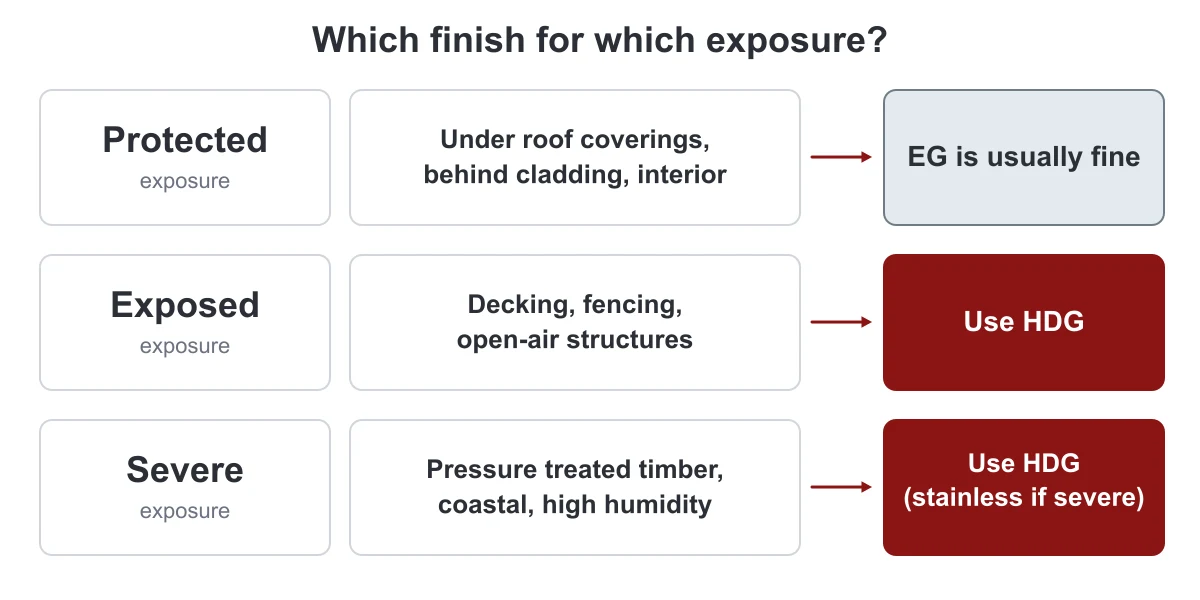
Outdoor work is not one condition. How long a nail lasts depends on how much weather reaches it. It helps to sort the job into one of three levels:
- Protected: under roof coverings, behind cladding, or indoors. Rain rarely reaches the nail.
- Exposed: decking, fencing and open-air structures, where the nail is wet again and again.
- Severe: pressure treated timber, coastal sites and high-humidity areas.
Why EG wears out outdoors
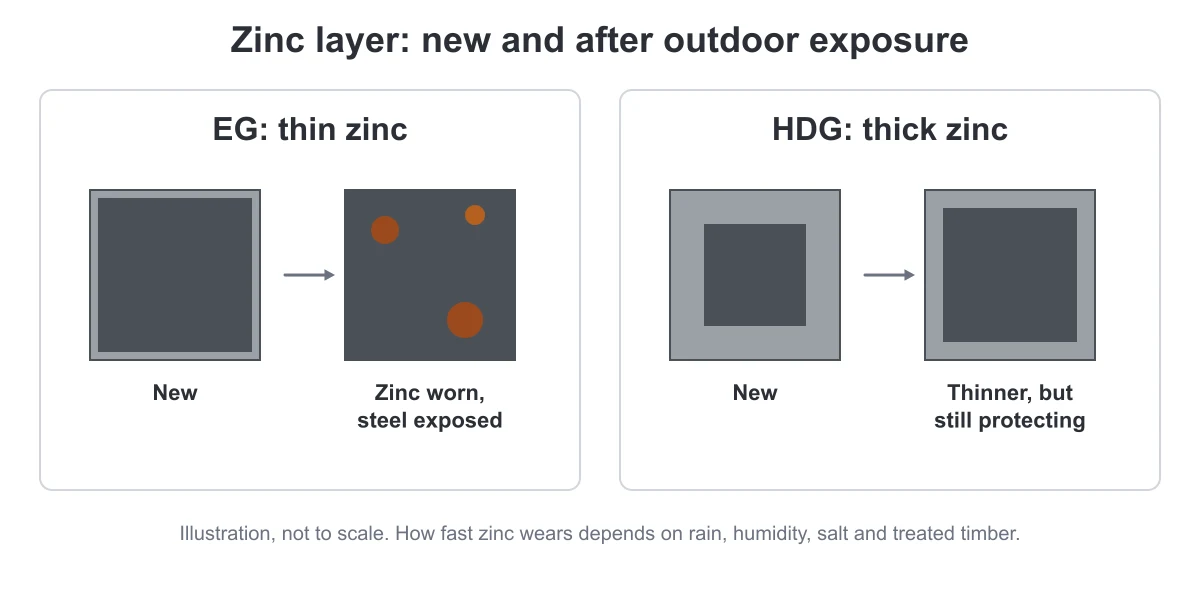
Zinc protects steel in two ways. It acts as a barrier, and it corrodes first so the steel underneath is protected. An EG nail gets its zinc by electroplating, so the layer is thin, smooth and bright. In dry or protected use that is enough. Outdoors, the thin layer is used up sooner. Once the zinc has gone, the steel can rust, and rust can stain the timber around the nail and weaken the joint.
An HDG nail is dipped in molten zinc, which leaves a much thicker, matte grey coating. The same weather takes much longer to wear through it.
EG or HDG: job by job
| Job | Electro-galvanized (EG) | Hot-dip galvanized (HDG) |
|---|---|---|
| Interior framing | Suitable | Not usually needed |
| Asphalt shingle roofing | Common | Used in coastal and high-wind areas, or where required |
| Behind cladding or siding | Often suitable | Suitable |
| Decking and fencing | Not recommended | Recommended |
| Pressure treated timber | Not recommended | Recommended |
| Coastal or high-humidity sites | Not recommended | Recommended (stainless steel for severe exposure) |
Pressure treated wood needs extra care
Modern wood preservatives contain copper, which can corrode plain or thinly coated steel faster. For that reason, many building codes call for hot-dip galvanized (or stainless steel) fasteners in pressure treated lumber. Always check the code that applies to your project and the preservative manufacturer's guidance.
Four questions to decide
- Will rain or damp reach the nail? If yes, lean towards HDG.
- Is the timber pressure treated? If yes, use HDG or stainless steel.
- Is the site coastal or very humid? If yes, use HDG, or stainless steel for severe exposure.
- Does the code or the engineer specify a finish? Follow it, whatever the rest of this guide says.
What to confirm with your supplier
- The finish on the quotation: bright, EG or HDG.
- Samples before a bulk order, so you can test the nails in your own timber and tools.
- If your order needs a coating test, a recognised third-party laboratory can test the goods after production, and the report can be provided with your order.
Pavandeal Homecare Pvt Ltd manufactures coil nails in both finishes. See our electro-galvanized coil nails and hot-dip galvanized coil nails, and for roofing work our roofing coil nails. For a fuller side-by-side comparison, read hot-dip galvanized vs electro-galvanized nails.
FAQ
Are electro-galvanized nails rust proof?
No. EG nails resist rust in storage and in dry or protected use, but the thin zinc layer wears away outdoors. No galvanized nail lasts forever, and HDG lasts much longer than EG in the same weather.
Can I use electro-galvanized nails for a fence or deck?
It is not recommended. Use hot-dip galvanized nails, or stainless steel for severe exposure.
Are electro-galvanized nails OK for roofing?
EG is common for asphalt shingle roofing coils. In coastal or high-wind areas, or where the code requires it, use HDG.
Do you supply both finishes?
Yes. Pavandeal Homecare Pvt Ltd manufactures coil nails in both EG and HDG and can quote them side by side.