
Short answer: Wire collated coil nails are tougher, handle rough transport and cold weather better, and are the most common choice for pallet and framing work. Plastic strip collated coil nails leave no wire pieces on the surface, which makes them popular for siding, fencing and visible exterior work. Always check that your nailer accepts the collation type.
What does "collated" mean?
Collated nails are joined together so a pneumatic nailer can feed them automatically. Coil nails are collated in a long strip and wound into a round coil, usually at a 15 degree angle. The two common collation materials are thin steel wire and plastic.
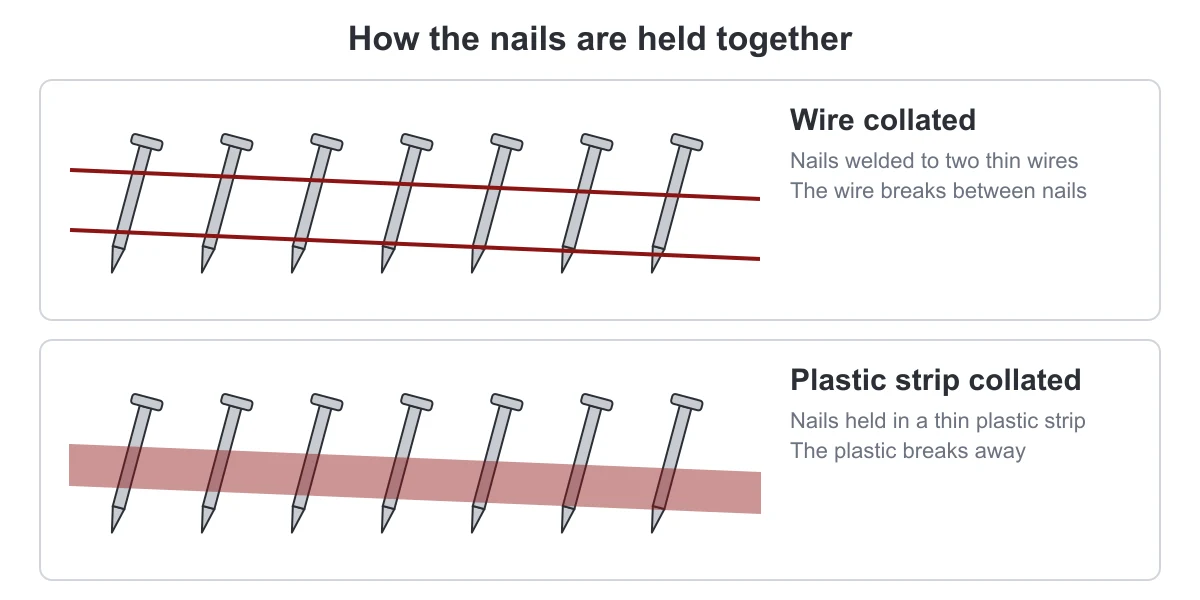
Wire collated coil nails
The nails are welded to two thin steel wires. When the nail is driven, the wire breaks between nails.
Advantages
- Strong and stable in transport and handling
- Performs well in cold weather, when plastic can become brittle
- Widely used in pallet plants and timber frame production
- Large coil counts help reduce reloading
Things to know: small wire pieces can remain on the work surface or fly off. That rarely matters on pallets or framing, but it can mark visible finishes.
Plastic strip collated coil nails
The nails are held in a thin plastic strip. When the nail is driven, the plastic breaks away.
Advantages
- No wire fragments on finished surfaces
- Cleaner look on siding, fencing and trim
- Often preferred where fragments could damage finishes or machinery
Things to know: plastic can crack in very cold conditions or with rough handling, and not every nailer accepts plastic collation.
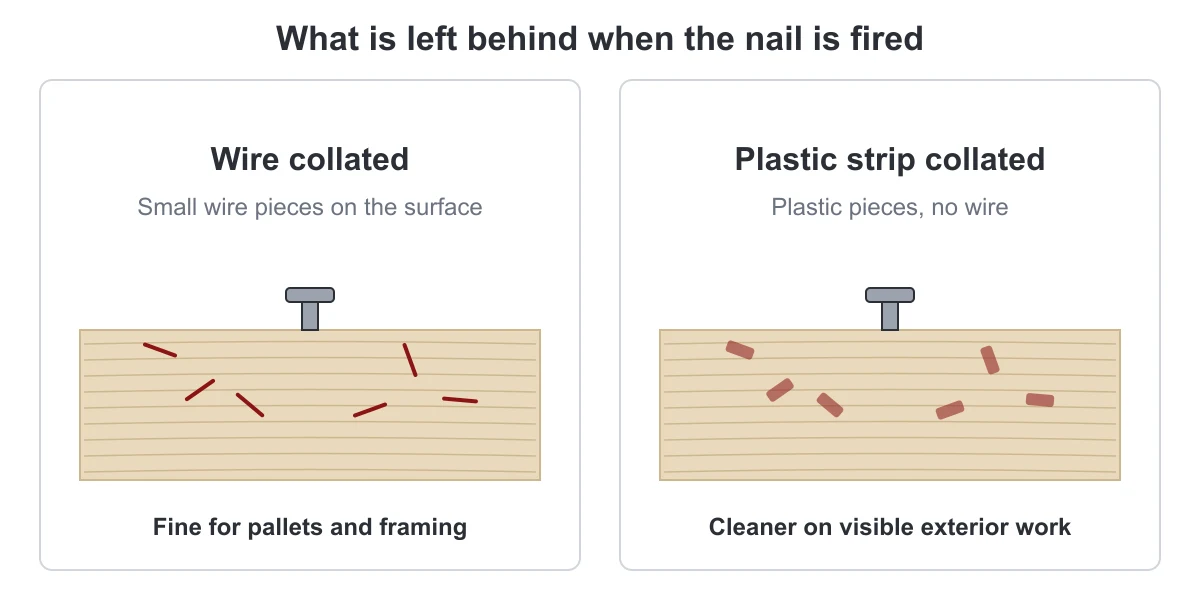
Comparison table
| Wire collated | Plastic strip collated | |
|---|---|---|
| Durability in handling | High | Medium |
| Cold weather | Good | Can become brittle |
| Debris on surface | Small wire pieces | Plastic pieces, no wire |
| Typical uses | Pallets, crates, framing, sheathing, roofing | Siding, fencing, exterior trim |
| Tool fit | Most 15 degree coil nailers | Nailers that accept plastic collation |
How to choose
- Check your nailer. Look at the tool manual or magazine label. Many 15 degree coil nailers accept both, some accept only one.
- Think about the surface. Visible exterior work favours plastic strip. Pallets and structural work usually use wire.
- Think about climate and storage. For cold sites or long storage, wire collation is the safer choice.
- Match the coil size. Share your nailer make and model so the coil diameter and collation fit the magazine.
See our wire collated coil nails and plastic strip coil nails. For siding work, see siding coil nails.
FAQ
Are wire and plastic coil nails interchangeable?
Only if your nailer accepts both. Always check the tool specification.
Which is better for pallets?
Wire collation is the most common choice in pallet plants because of its strength in handling and long shifts.
Which is better for siding?
Plastic strip is popular for siding because it does not leave wire pieces on the finished surface.
Can I get both from one supplier?
Yes. Pavandeal Homecare Pvt Ltd manufactures both wire collated and plastic strip coil nails, so both can ship in one container.