
Short answer: Smooth shank nails drive fastest and are the standard choice for general framing. Ring shank nails hold much better against pull-out, so they suit pallets, sheathing and subfloors in softwood. Screw shank nails twist as they enter the wood, which makes them a good choice for hardwood and timber that moves as it dries.
What is the shank of a nail?
The shank is the long body of the nail between the head and the point. Its surface decides how the nail grips the wood. All three types below are available as 15 degree collated coil nails for pneumatic nailers, so the choice is about the job, not the tool.
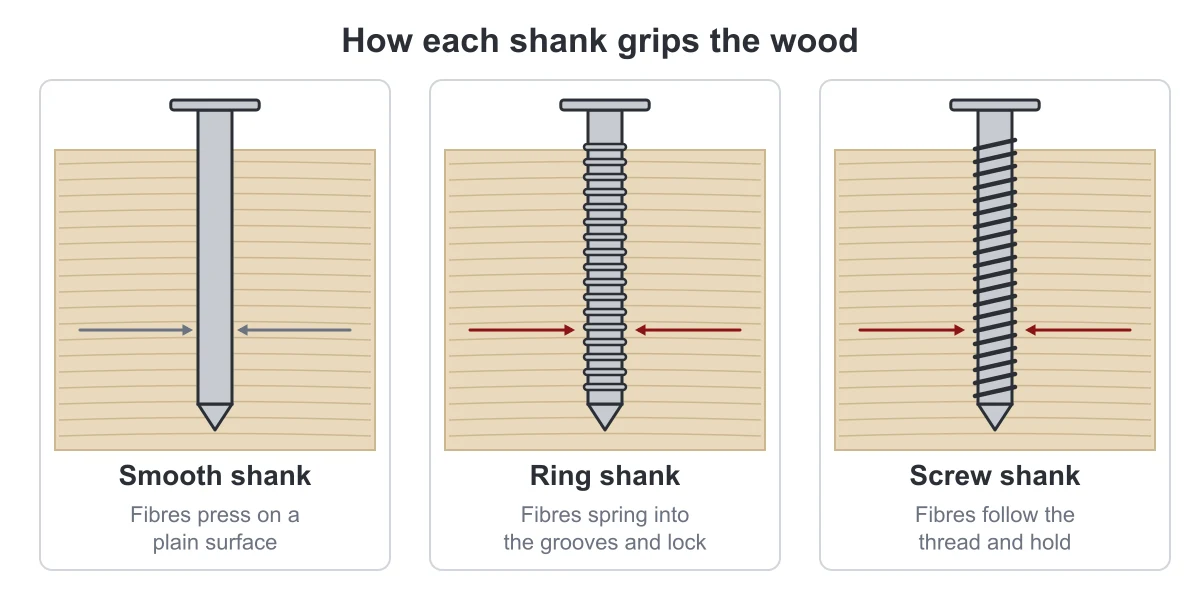
Smooth shank nails
A smooth shank nail has a plain, round body. It drives quickly, needs less force and is less likely to split the timber. Smooth shank nails give good shear strength, which is what matters in most structural framing joints, where the load pushes sideways across the nail rather than pulling it out.
Best for: wall framing, timber frame panels, sheathing, boxes and general interior construction.
Limit: lower withdrawal resistance. If the joint will vibrate, flex or be pulled apart, a deformed shank is a better choice.
Ring shank nails
A ring shank (also called annular ring) nail has a series of rings rolled along the shank. As it is driven, the wood fibres spring back into the grooves between the rings and lock the nail in place. This gives much higher withdrawal resistance than a smooth nail of the same size.
Best for: pallets and crates in softwood, subfloors, sheathing, roofing, fencing and any joint that must not work loose.
Limit: slightly harder to drive and very hard to remove, which is the point.
Screw shank nails
A screw shank nail has a twisted, helical thread. It turns slightly as it is driven, which helps it enter dense timber with less splitting and hold firmly as the wood dries and shrinks.
Best for: hardwood pallets and skids, heavy crates, green or freshly sawn timber, hardwood flooring and decking.
Limit: in soft timber the extra cost over ring shank is often not needed.
Comparison table
| Smooth shank | Ring shank | Screw shank | |
|---|---|---|---|
| Holding power (pull-out) | Standard | High | High |
| Driving effort | Lowest | Medium | Medium |
| Best timber | Softwood, general | Softwood | Hardwood, green timber |
| Typical uses | Framing, sheathing, boxes | Pallets, subfloors, roofing, fencing | Hardwood pallets, crates, flooring |
Which one should you choose?
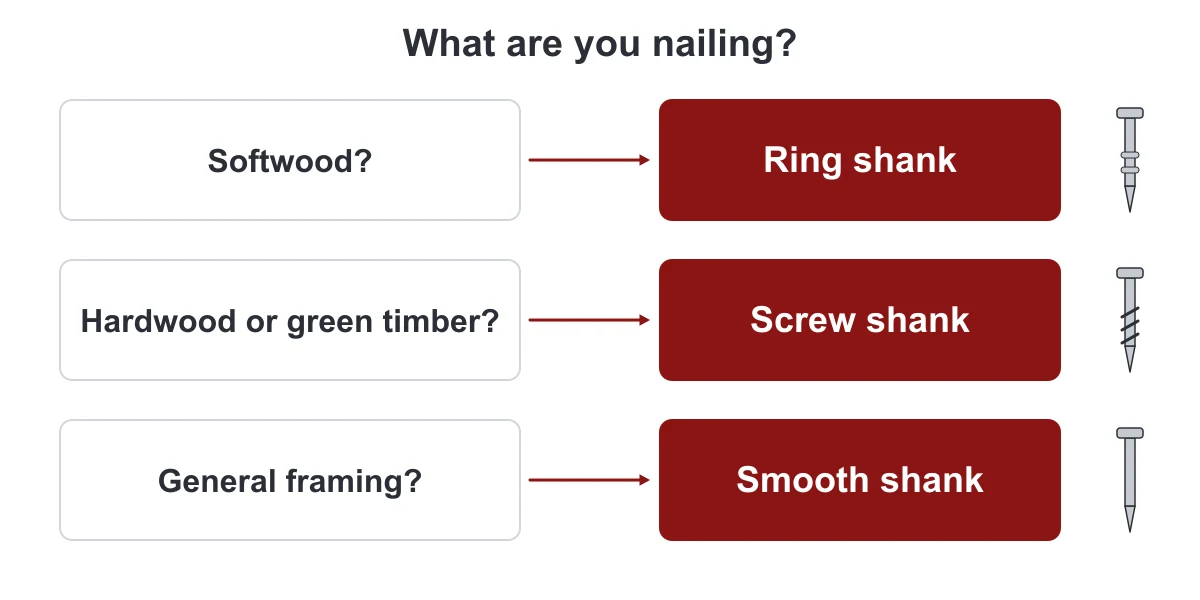
- Building softwood pallets or crates: ring shank. See our pallet coil nails.
- Hardwood pallets or green timber:screw shank.
- Wall framing and general construction:smooth shank.
- Subfloors, sheathing, roofing and fencing:ring shank.
- Outdoor or pressure treated timber: whichever shank you choose, use a hot-dip galvanized finish.
If you are replacing nails from an existing supplier, send us the size, diameter, shank and finish, or a sample box, and we will match it.
FAQ
Is ring shank stronger than smooth shank?
Ring shank has much higher withdrawal (pull-out) resistance. For sideways (shear) loads, both perform well, which is why smooth shank is still standard for framing.
Can I use ring shank nails for framing?
Yes, but check your local building code and the engineer's specification. Many framing schedules are written for smooth shank nails of a given diameter.
What is the difference between ring shank and screw shank?
Ring shank has separate rings that lock wood fibres. Screw shank has a continuous twisted thread that turns as it is driven, which suits harder and moving timber.
Are all three available as coil nails?
Yes. Pavandeal Homecare Pvt Ltd manufactures smooth, ring and screw shank 15 degree coil nails in bright, electro-galvanized and hot-dip galvanized finishes.